¶ Overview:
This article shares 5 practical 3D insights that help improve print quality, save time, reduce filament waste, and support environmentally responsible printing.
¶ 1. Printing in Vase Mode
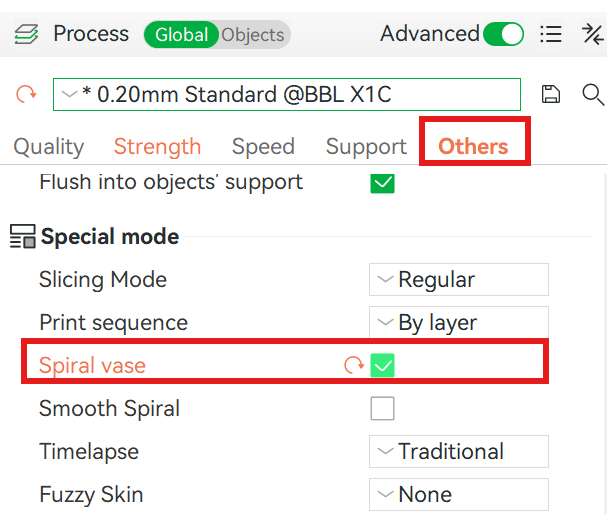
Vase mode, or Spiralize Outer Contour, prints a single continuous outer wall while the nozzle gradually moves upward. Instead of layering with visible start and stop points, the nozzle follows a smooth spiral path.
How to use:
Enable Vase Mode or Spiralize Outer Contour in your slicer.
Benefits:
- Saves filament
- Reduces print time
- Produces smooth surfaces with no Z-seams
Best for:
- Decorative or lightweight objects such as vases, planters, lampshades, and simple containers.
- Not recommended for structural or load-bearing parts.

2. Printing by Object Instead of by Layer
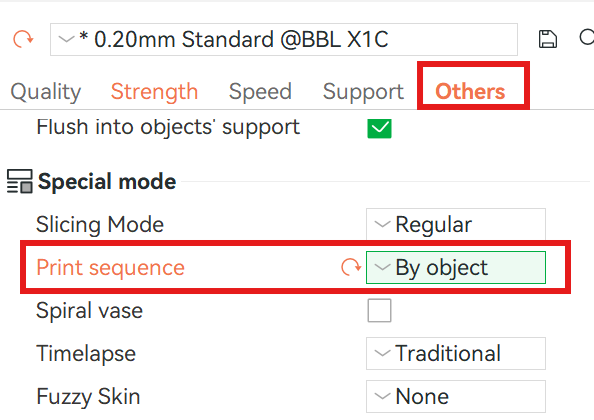
Print by Object mode changes the standard printing sequence by fully completing one model before moving on to the next, rather than printing all models one layer at a time. This approach is particularly useful for small production runs or when printing multiple different parts, as it reduces the risk of failed prints affecting other objects and helps maintain consistent print quality for each model.
Benefits:
- Prevents one failed print from affecting all objects
- Reduces filament waste
- Minimizes stringing between parts
Requirements:
- Ensure sufficient spacing between objects
- Check printer clearance to avoid collisions

3. Using Spool Adapters for Bent Cardboard Spools
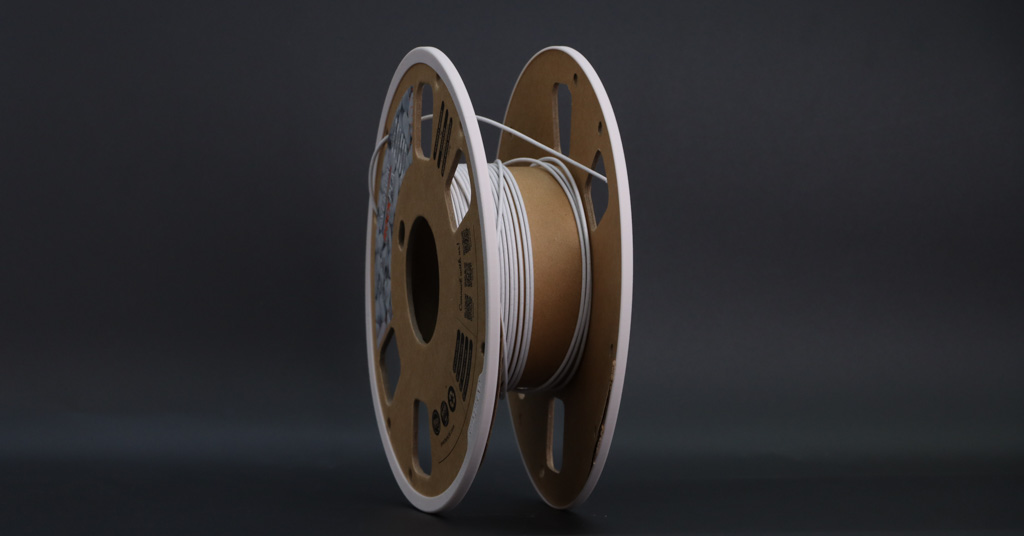
Cardboard spools are environmentally friendly but can deform, causing feeding issues. A bent spool may wobble or increase tension, leading to inconsistent extrusion and occasional jams.
Solution:
Use a printed spool adapter or hub. Adapters reinforce the spool center, restore smooth rotation, and ensure consistent filament feeding, making it easier to handle deformed spools while maintaining print quality.
Benefits:
- Reinforces the spool center and restores smooth rotation
- Improves filament feeding and reduces extrusion problems
- Extends the usable life of cardboard spools, lowering waste and cost

4. Nozzle Size Affects Strength and Detail
Nozzle diameter affects how much filament is extruded per second, which in turn influences layer bonding, part strength, surface detail, and printing speed. Larger nozzles deposit more material at once, improving layer adhesion and overall strength but reducing fine detail. Smaller nozzles deposit less material, allowing higher resolution and more intricate features, but require precise temperature control and are more sensitive to filament quality and moisture
Large nozzles (0.5 – 1.0 mm+):
- Advantages: Stronger layer bonding, faster printing, less sensitive to minor under-extrusion
- Disadvantages: Lower surface detail, less precise fine features
Small nozzles (0.2 – 0.4 mm):
- Advantages: Higher detail and resolution, better for intricate parts
- Disadvantages: Slower printing, more sensitive to filament quality and moisture, weaker layer bonding if not optimized

5. Food Safety Considerations for 3D Printing
No 3D printing filament is FDA-certified as food safe. Food safety depends on the final printed object and the entire production process, not just the raw material.
Risks during printing:
- Layer lines and microscopic gaps trap bacteria and contaminants
- The build environment can introduce dust or particles
- Brass nozzles may transfer trace lead onto prints
Because of these factors, 3D-printed parts should not be assumed safe for direct food contact. Exercise caution and limit use to non-food-contact purposes unless proper testing and post-processing are performed.